Randy E. Bennett, Principal
Major Publications
Personalizing Assessment: Dream or Nightmare?
Over our field's 100-year-plus history, standardization has been a central assumption in test theory and practice. The concept's justification turns on leveling the playing field by presenting all examinees with putatively equivalent experiences. Until relatively recently, our field has accepted that justification almost without question. In this article, I present a case for standardization's antithesis, personalization. Interestingly, personalized assessment has important precedents within the measurement community. As intriguing are some of the divergent ways in which personalization might be realized in practice. Those ways, however, suggest a host of serious issues. Despite those issues, both moral obligation and survival imperative counsel persistence in trying to personalize assessment.
Bennett, R.E. (2024), Personalizing Assessment: Dream or Nightmare? Educational Measurement: Issues and Practice, 43, 119-125. https://doi.org/10.1111/emip.12652
Rethinking Equity and Assessment through Opportunity to Learn
Using the method of narrative review, this paper considers the impact of structural inequity in US society and its implications for educational assessment. Focusing on African Americans, some of the many past and present examples of structural inequity and their effects are delineated. Described next are how these effects can be connected to opportunity to learn (OTL), very broadly conceived, and how the persistence of so-called achievement gaps might be seen from that OTL perspective. Based on the conception derived from the review, a graphical representation is given positing how structural inequity, through OTL, works to constrain achievement and life chances cumulatively over time. Understanding OTL from this broad-ranging, cumulative perspective suggests ways in which the design and use of K-12 and higher education assessment might be rethought.
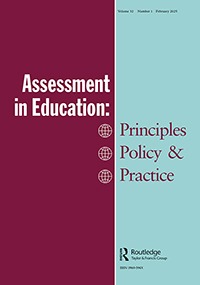
Bennett, R. E. (2025). Rethinking equity and assessment through opportunity to learn. Assessment in Education: Principles, Policy & Practice, 32(1), 5–32. https://doi.org/10.1080/0969594X.2025.2462549


A Preliminary Research and Evaluation Agenda for Personalized Assessment in the Service of Equity
This research memorandum describes a preliminary research and evaluation agenda for personalized assessments, where such assessments are intended to be attuned to the social, cultural, and other relevant characteristics of individuals and the contexts from which they come. The agenda targets the full range of assessment uses—school accountability, national and international assessment, admissions, certification and licensure, and instructional planning. The purposes of the agenda are to guide the theoretical and empirical research and development needed to create personalized assessments and to suggest a means for judging the effectiveness of those instruments.
Bennett, R. E., Sparks, J. R., Arslan, B., Lehman, B., Sinharay, S., & Zapata-Rivera, D. (2025). A preliminary research and evaluation agenda for personalized assessment in the service of equity (Research Memorandum No. RM-26-01). ETS. https://doi.org/10.64634/wjv5e895


Toward a Theory of Socioculturally Responsive Assessment
In the United States, opposition to traditional standardized tests is widespread, particularly obvious in the admissions context but also evident in elementary and secondary education. This opposition is fueled in significant part by the perception that tests perpetuate social injustice through their content, design, and use. To survive, as well as contribute positively, the measurement field must rethink assessment, including how to make it more socioculturally responsive. This paper offers a rationale for that rethinking and then employs provisional design principles drawn from various literatures to formulate a working definition and the beginnings of a theory. In the closing section, a path toward implementation is suggested.
Bennett, R. E. (2023). Toward a Theory of Socioculturally Responsive Assessment. Educational Assessment, 28(2), 83–104. https://doi.org/10.1080/10627197.2023.2202312
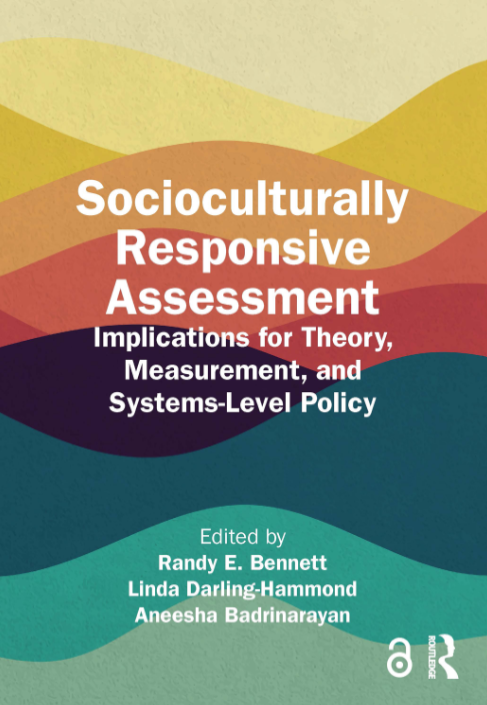
Socioculturally Responsive Assessment: Implications for Theory, Measurement, and Systems-Level Policy
Socioculturally Responsive Assessment assembles the best-available thinking from within and outside the educational measurement community about the theoretical foundations and systems-level policy implications of formal assessment programs designed to be socioculturally responsive. Synthesized from culturally responsive assessment design and practices, culturally relevant pedagogy and funds of knowledge, universal design for learning, the learning sciences, and other literatures, this emerging concept affirms that students’ learning and performance is inextricably tied to the social, cultural, and linguistic contexts in which they live and develop knowledge. Across four sections, this book provides an argument and initial evidence for impact on students, users, and assessment quality; offers guidance for implementation; and examines the potential limitations, pitfalls, barriers, and measurement issues that such programs will inevitably raise. Scholars, teaching faculty, test developers, and policymakers will come away with integral foundations, new assessment approaches, and a greater sense of the potential for positive impact that these assessments may afford.
Bennett, R.E., Darling-Hammond, L., & Badrinarayan, A. (Eds.). (2025). Socioculturally Responsive Assessment: Implications for Theory, Measurement, and Systems-Level Policy (1st ed.). Routledge. https://doi.org/10.4324/9781003435105
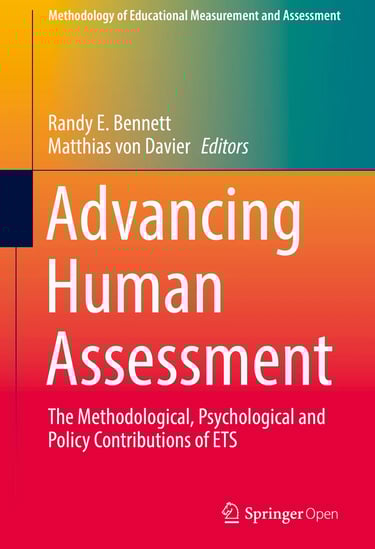
Advancing Human Assessment: The Methodological, Psychological and Policy Contributions of ETS
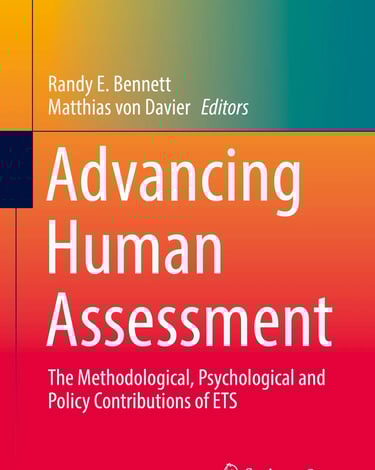
This book describes the extensive contributions made toward the advancement of human assessment by scientists from one of the world’s leading research institutions, Educational Testing Service. The book’s four major sections detail research and development in measurement and statistics, education policy analysis and evaluation, scientific psychology, and validity. Many of the developments presented have become de-facto standards in educational and psychological measurement, including in item response theory (IRT), linking and equating, differential item functioning (DIF), and educational surveys like the National Assessment of Educational Progress (NAEP), the Programme of international Student Assessment (PISA), the Progress of International Reading Literacy Study (PIRLS) and the Trends in Mathematics and Science Study (TIMSS). In addition to its comprehensive coverage of contributions to the theory and methodology of educational and psychological measurement and statistics, the book gives significant attention to ETS work in cognitive, personality, developmental, and social psychology, and to education policy analysis and program evaluation. The chapter authors are long-standing experts who provide broad coverage and thoughtful insights that build upon decades of experience in research and best practices for measurement, evaluation, scientific psychology, and education policy analysis. Opening with a chapter on the genesis of ETS and closing with a synthesis of the enormously diverse set of contributions made over its 70-year history, the book is a useful resource for all interested in the improvement of human assessment.
Bennett, R. E., & von Davier, M. (Eds.). (2017). Advancing human assessment: The methodological, psychological, and policy contributions of ETS. Cham, Switzerland: Springer Open.
Formative Assessment: A Critical Review
This paper covers six interrelated issues in formative assessment (aka, ‘assessment for learning’). The issues concern the definition of formative assessment, the claims commonly made for its effectiveness, the limited attention given to domain considerations in its conceptualisation, the under‐representation of measurement principles in that conceptualisation, the teacher‐support demands formative assessment entails, and the impact of the larger educational system. The paper concludes that the term, ‘formative assessment’, does not yet represent a well‐defined set of artefacts or practices. Although research suggests that the general practices associated with formative assessment can facilitate learning, existing definitions admit such a wide variety of implementations that effects should be expected to vary widely from one implementation and student population to the next. In addition, the magnitude of commonly made quantitative claims for effectiveness is suspect, deriving from untraceable, flawed, dated, or unpublished sources. To realise maximum benefit from formative assessment, new development should focus on conceptualising well‐specified approaches built around process and methodology rooted within specific content domains. Those conceptualisations should incorporate fundamental measurement principles that encourage teachers and students to recognise the inferential nature of assessment. The conceptualisations should also allow for the substantial time and professional support needed if the vast majority of teachers are to become proficient users of formative assessment. Finally, for greatest benefit, formative approaches should be conceptualised as part of a comprehensive system in which all components work together to facilitate learning.
Bennett, R. E. (2011). Formative assessment: a critical review. Assessment in Education: Principles, Policy & Practice, 18(1), 5–25. https://doi.org/10.1080/0969594X.2010.513678
Technology Based Assessment: Validity, Modeling, and Analysis Issues
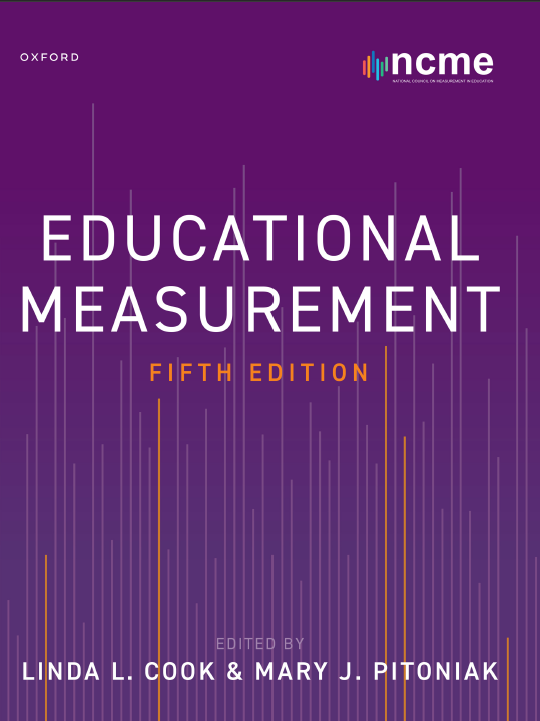
This chapter focuses on validity, modeling, and analysis issues in technology-based assessment (TBA), where TBA is defined as a measurement used for decision making primarily in education, but also in the workplace, that employs digital computing in most, if not all, aspects of its creation, delivery, presentation, scoring, or reporting. The first section centers on assessments used to support consequential purposes, encompassing decisions that may have highly significant impact on individuals, groups, or institutions and that are often difficult to reverse. The second section covers assessments employed for in-the-moment instructional decisions or for describing what a student knows and can do so that near-term instructional next steps can be taken. The last major section explores the idea of combining both assessment purposes—i.e., consequential decision making and instructional support--in the same assessment. The chapter concludes with a summary of key points, recommendations for research, and speculation on future directions.
Bennett, R. E., LaMar, M., & Mazzeo, J. (2025). Technology-based assessment: Validity, modeling, and analysis issues. In L. L. Cook & M. J. Pitoniak (Eds.), Educational measurement (5th ed., pp. 581–654). Oxford University Press. DOI: 10.1093/oso/9780197654965.003.0009.
Google Scholar Citations